
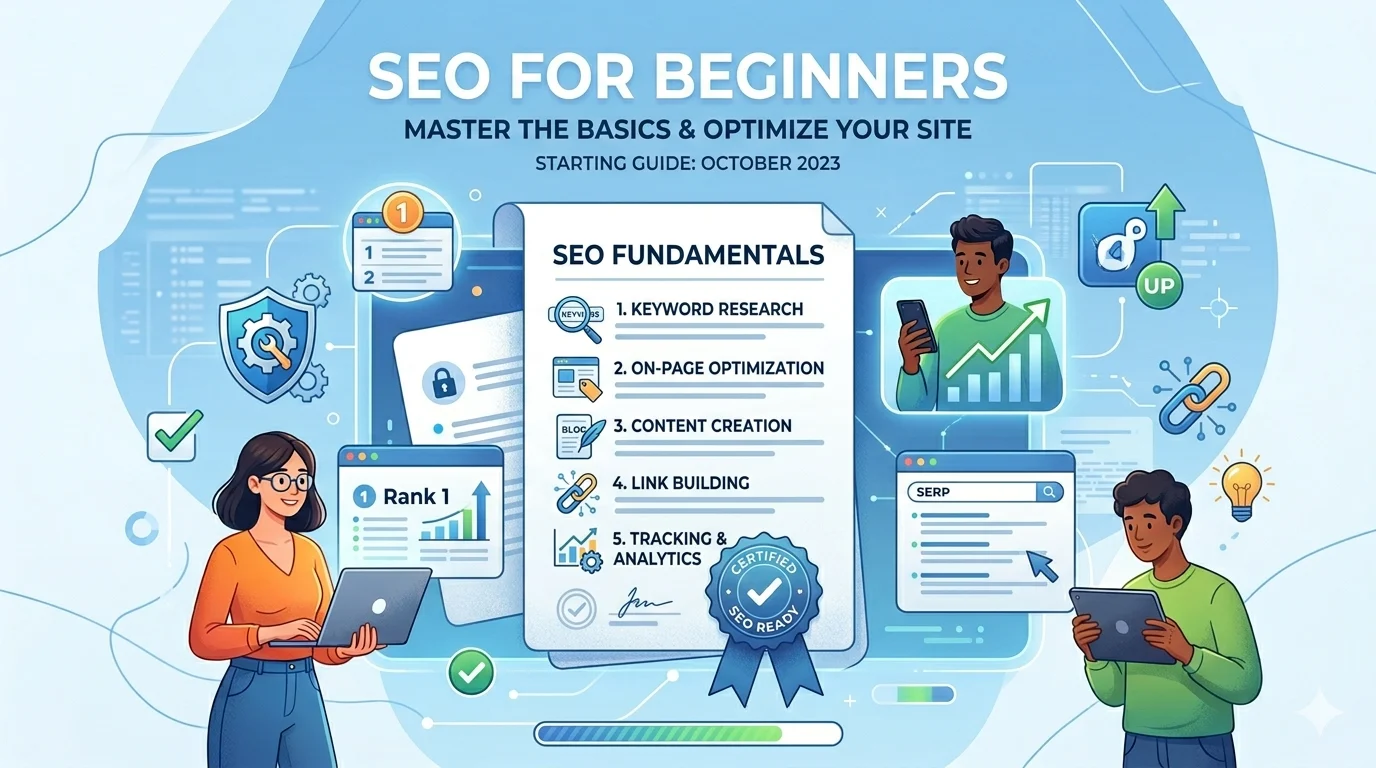
SEO for Beginners
Learn SEO Free — Start Ranking Today
The complete SEO for beginners guide — learn on-page optimization, technical SEO, keyword research, and link building. Practice every concept with 74 free tools. No experience needed.
What Is SEO? A Beginner’s Explanation
SEO for beginners starts here: SEO stands for Search Engine Optimization — the practice of improving your website so it appears higher in Google search results when people search for topics related to your business or content. Higher rankings mean more visitors, and more visitors mean more customers, readers, or revenue.
When someone types a query into Google, Google’s algorithm scans billions of pages and ranks them in order of relevance and authority. Relevance means — does this page actually answer what the person searched for? Authority means — is this website trusted? Do other reputable sites link to it? Your job as a website owner is to make your pages as relevant and authoritative as possible.
The good news: SEO is not a mystery. It follows clear, learnable principles. And unlike paid advertising, SEO traffic is free — once you rank, you receive visitors without paying Google a single cent per click. A page that ranks #1 today can still bring traffic three years from now with no ongoing cost.
For the most authoritative reference on how Google evaluates websites, bookmark Google’s official SEO Starter Guide — the foundation every beginner should read alongside this guide.
This guide covers the four pillars of SEO in plain English — with a free tool to practice each one. SEO for beginners does not need to be complicated. Start from the top and work through each section in order.
The 4 Pillars of SEO Every Beginner Must Know
Master these four areas — in this order — and as a beginner in SEO you will outrank 90% of websites in your niche.
1. On-Page SEO
Optimizing content and HTML of each page — title tags, meta descriptions, headings, keyword usage, and internal linking. Start here.
Free Tool →2. Technical SEO
Making sure Google can find, crawl, and index your pages. Speed, mobile-friendliness, sitemaps, robots.txt, and Core Web Vitals.
Free Tool →3. Content & Keywords
Creating content that matches what people search for. Keyword research, keyword density, readability, and content length.
Free Tool →4. Off-Page SEO
Building authority through backlinks. Domain Authority, Trust Flow, niche-relevant link building strategies.
Free Tool →Beginner SEO Roadmap — Week by Week
Follow this exact sequence for your first 8 weeks. Every SEO for beginners journey should start with this roadmap — each step builds on the last.
Week 1 — Run a Full SEO Audit
Before doing anything, understand your current state. The first step in any SEO for beginners plan is running the SEO Audit Tool on your homepage and top 5 pages. Note your score and the top 5 issues flagged.
🔍 SEO Audit ToolWeek 2 — Fix Indexing & Technical Issues
Check all important pages are indexed by Google. Fix any pages blocked by robots.txt or noindex tags. Check page speed.
🚀 Index CheckerWeek 3 — Optimize Title Tags & Meta Descriptions
Check every page’s title tag (under 60 chars with keyword) and meta description (150–160 chars with CTA).
🏷️ Meta CheckerWeek 4 — Fix Broken Links
Broken links waste Google’s crawl budget. Scan for 404 errors and redirect broken internal links to relevant live pages.
🔗 Broken Link CheckerWeek 5–6 — Optimize Content for Keywords
Aim for 1–2% keyword density. Check readability — Flesch score 60–70. Add missing LSI keywords naturally.
🔑 Content ToolsWeek 7–8 — Start Building Backlinks
Check your Domain Authority baseline. Focus on guest posting, resource page links, and directory submissions at DA 30+ sites.
💪 Link SignalsBest Free SEO Tools for Beginners
These 8 tools cover everything a beginner in SEO needs to start ranking — all free, no signup. The right tools make SEO for beginners much less overwhelming.
6 SEO Mistakes Every Beginner Makes
Avoid these common SEO for beginners mistakes and you will rank faster than 80% of others starting out.
Targeting Keywords Too Competitive
New sites cannot rank for broad terms. Target long-tail keywords first. Win small, then grow.
Publishing Without Checking Indexing
Always check Google Index Checker within 48 hours of publishing any new page.
Ignoring Page Speed
LCP under 2.5s is required for competitive rankings. Check Core Web Vitals immediately.
Expecting Results in 2 Weeks
SEO takes 3–6 months. Consistency beats intensity — publish and optimize regularly.
Buying Cheap Backlinks
PBN and link farm packages increase spam score and trigger Google penalties. Build links slowly.
Writing for Search Engines, Not People
Keyword stuffing hurts rankings. Write naturally for humans first, then check density is 1–2%.
Ready to Go Deeper?
Once you’ve mastered the basics of SEO for beginners, explore our specialized tool categories to go deeper.